Hagia Sophia's Golden Ratios: The Mystery of Mathematical Elegance and Divine Proportions (2026)
Hagia Sophia, a monument that has defied centuries in the heart of Istanbul, continues to mesmerize with its architecture and aesthetics. When we unveil the curtain of secrets behind this magnificent structure, one of the most striking facts that emerges is that the Hagia Sophia was designed according to golden ratio principles. This 2026 exploration delves into the mathematical elegance and divine proportions embedded in its construction.
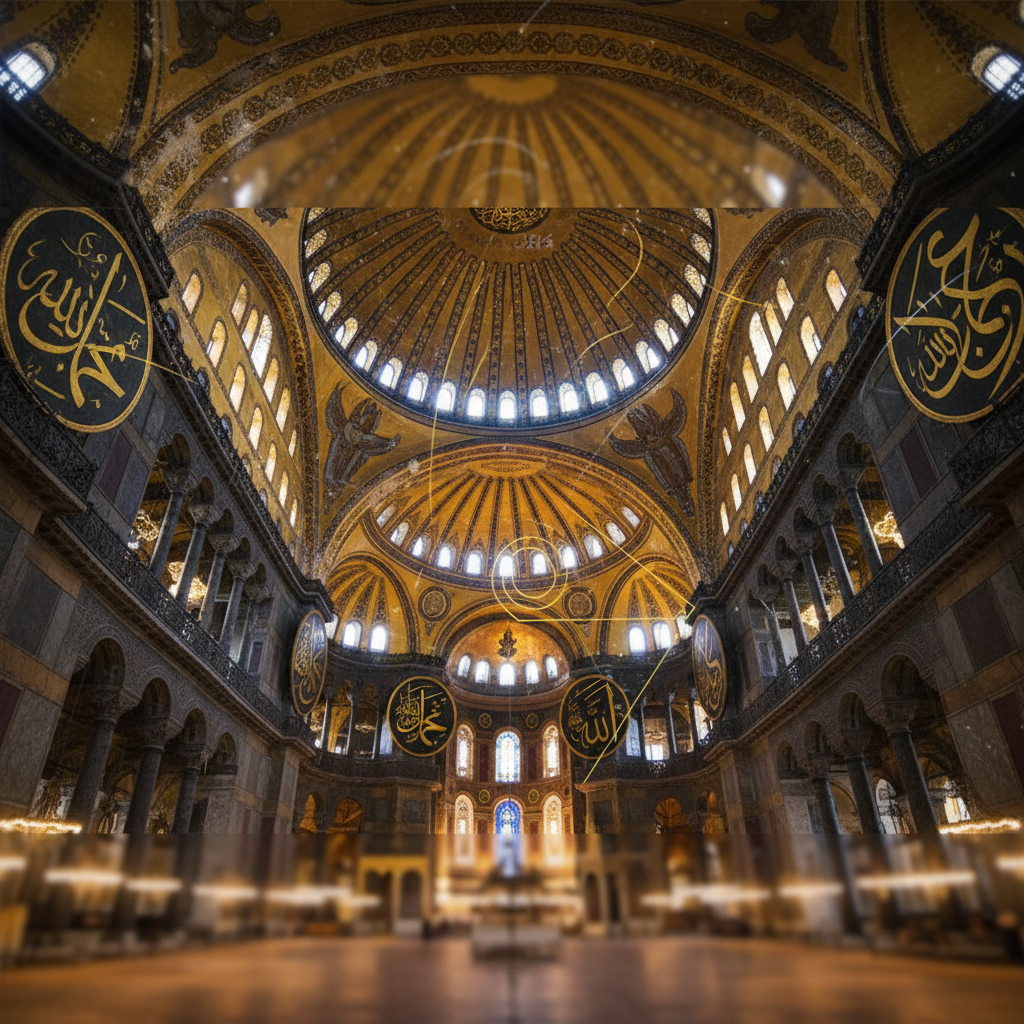
Hagia Sophia's Golden Ratio: Mystery of Mathematical Grace and Divine Proportions (2026)
Hagia Sophia, a monument that has defied centuries in the heart of Istanbul, continues to mesmerize with its architecture and aesthetics. When we unveil the curtain of secrets behind this magnificent structure, one of the most striking facts that emerges is the profound influence of Hagia Sophia's Golden Ratio. In this article, we will delve into the details of these divine proportions used in the construction of Hagia Sophia, examining the building's mathematical elegance and mystical charm from a 2026 perspective.
Hagia Sophia's Golden Ratio and Its Traces in Ancient Architecture
The "golden ratio" or "divine proportion" (Phi, approximately 1.618), discovered by many civilizations in architecture, art, and nature since ancient times, has found its place in masterpieces like Hagia Sophia. This ratio is considered to be the most aesthetically pleasing proportion to the human eye. It is possible to trace the golden ratio in many details of Hagia Sophia, from its massive dome to the placement of its columns, from the dimensions of its windows to the interior layout. This mathematical perfection forms the basis of the building's timeless beauty, a marvel explored further in articles such as Hagia Sophia's Architecture: Construction Techniques and Unknown Details from the Ancient World to 2026. Understanding Hagia Sophia's Golden Ratio provides crucial insights into its enduring appeal.
Historical Origins of the Golden Ratio
The history of the golden ratio dates back to ancient Greek philosophers and mathematicians Pythagoras and Euclid. It is believed that this ratio was consciously used in many ancient structures, from the Egyptian pyramids to the Parthenon temple. It is certain that Byzantine architects were aware of these principles and skillfully applied them in the 6th century, when Hagia Sophia was built. For a deeper understanding of this pivotal period, explore Justinian I's Vision: Building Hagia Sophia. This information will deeply affect visitors' perspective of Hagia Sophia, enriching their Through the Eyes of Every Visitor to Hagia Sophia: Lenses From the Past and Instantaneous Frames of 2026. The application of Hagia Sophia's Golden Ratio is a testament to this ancient knowledge.
Importance of Architectural Knowledge
The chief architects of Hagia Sophia, Anthemius and Isidore, are known not only as the best engineers of their time but also as academics with advanced knowledge of mathematics and geometry. Their unique combination was the key to blending divine proportions with aesthetics in Hagia Sophia. Even today, in 2026, such a level of knowledge and application astonishes observers, hinting at Hagia Sophia's Cosmic Connections: Celestial Architecture and Star Maps (2026). For further insights into the global significance of such architectural feats, see recent analyses on National Geographic's articles on Hagia Sophia's transformations and its enduring historical impact. Additional details about the mathematical and artistic confluence can be found in academic papers such as those indexed on Google Scholar regarding Byzantine architecture and the golden ratio, offering a comprehensive look at how these concepts were integrated. For a broader appreciation of ancient engineering, the History Channel's discussions on ancient architectural wonders provide context to the sophistication found in Hagia Sophia. The mastery of Hagia Sophia's Golden Ratio by its architects is truly remarkable.
Hagia Sophia's Geometric Structure and Golden Ratio Relationship
The general planning of Hagia Sophia exhibits a geometric harmony that encompasses the entire structure, starting from its central dome. The influence of the golden ratio is evident in this harmony. The ratio of the building's external facade width to its height, the column arrangements in the main nave, the symmetry of the windows, and the overall spatial organization all reflect the principles of Hagia Sophia's Golden Ratio. This meticulous application contributes significantly to the building's aesthetic appeal and structural integrity.
The Timeless Beauty of Hagia Sophia Through Golden Ratio
The enduring allure of Hagia Sophia is not merely due to its historical significance but also its profound architectural design, deeply rooted in the golden ratio. This divine proportion creates a visual balance and harmony that resonates with observers across centuries. The careful integration of Hagia Sophia's Golden Ratio in its every detail ensures a sense of perfection and timelessness, making it a masterpiece of human ingenuity and mathematical precision.
Hagia Sophia's Golden Ratio in Modern Analysis
Even in 2026, researchers and architects continue to study Hagia Sophia, uncovering new layers of its mathematical brilliance. Modern analytical tools allow for precise measurements that confirm the pervasive use of the golden ratio throughout the structure. This ongoing fascination with Hagia Sophia's Golden Ratio highlights its importance not just as a historical artifact but as a living lesson in architectural excellence and mathematical harmony.