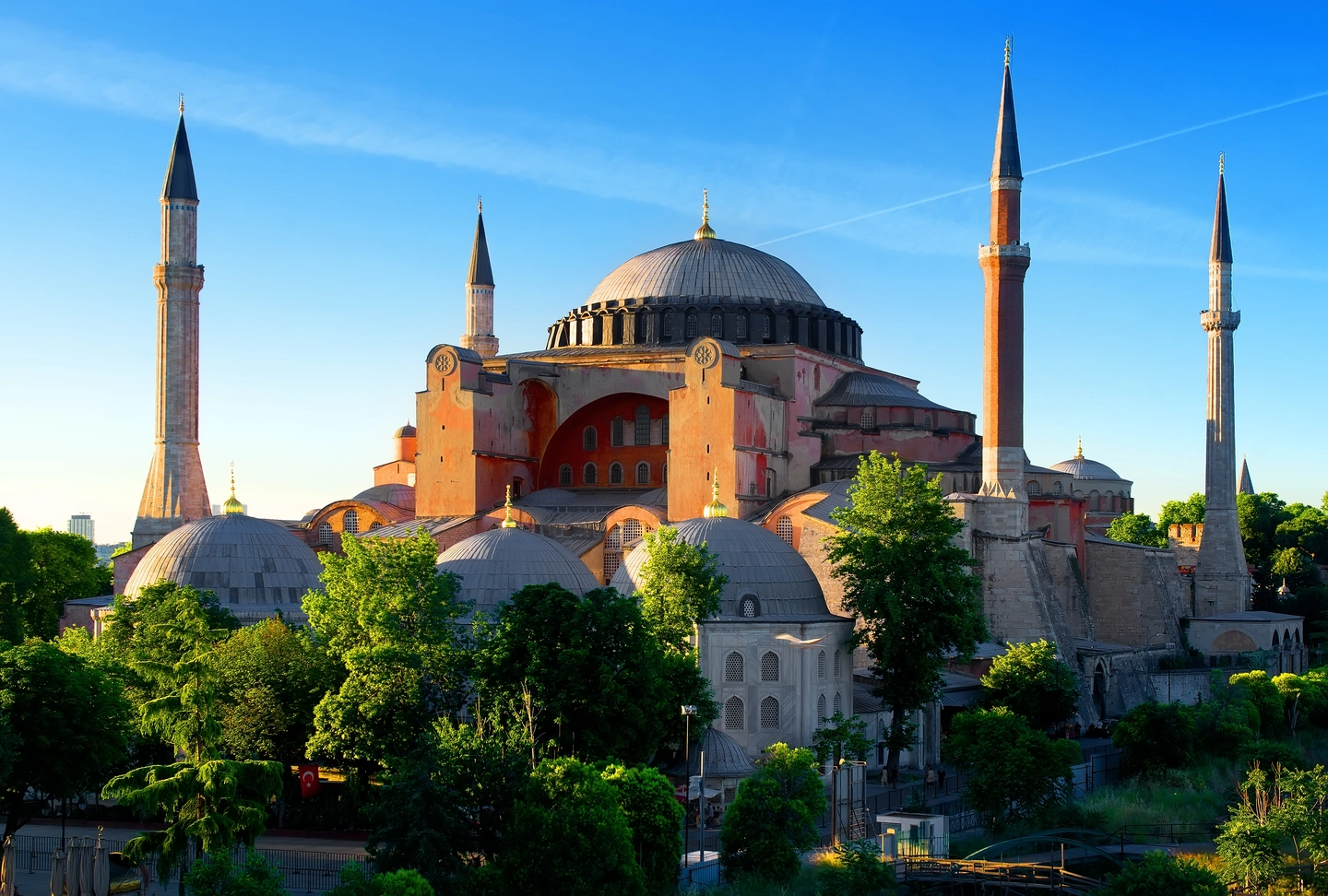
Hagia Sophia Before and After
Nearly 1,500 years of transformation — from Byzantine cathedral to Ottoman mosque to modern landmark. Discover what changed, what survived, and what was lost along the way.
Timeline of Transformations
Each era left its mark on Hagia Sophia. These five turning points reshaped the building's appearance, function, and meaning.
Original Construction Under Justinian
Emperor Justinian I completed the greatest cathedral in Christendom. The interior glowed with golden mosaics, the massive dome soared 55 meters high, and a large cross crowned the rooftop. No minarets, no mihrab — a purely Byzantine Christian cathedral.
Conversion to Ottoman Mosque
After the fall of Constantinople, Sultan Mehmed II converted Hagia Sophia into a mosque. Minarets were added to the exterior, Christian mosaics were plastered over, a mihrab was installed facing Mecca, and the cross was replaced with a crescent.
Fossati Brothers Restoration
Swiss-Italian architects Gaspare and Giuseppe Fossati undertook a major restoration. They uncovered and meticulously documented Byzantine mosaics hidden for centuries, then covered them again per Ottoman orders. Their drawings remain invaluable records today.
Museum Conversion Under Ataturk
Ataturk secularized the building and opened it as a museum. Plaster was carefully removed to reveal Byzantine mosaics once more. Both Christian and Islamic elements were preserved side by side, allowing visitors to see the full layered history.
Reconversion to Active Mosque
A Turkish court ruling returned Hagia Sophia to mosque status. Carpets were laid over the marble floors, mosaics are covered with curtains during the five daily prayers, and the building once again serves as a place of active Islamic worship.
What Changed in Each Era
Side-by-side comparisons of how Hagia Sophia's exterior, interior, and function evolved across its major historical periods.
Exterior
No minarets, single dome with cross, Byzantine buttresses only
Four minarets added over centuries, Ottoman buttresses and fountains, crescent replaces cross
Interior — Mosaics
Brilliant gold mosaics fully visible: Christ, Virgin Mary, saints, emperors
Mosaics plastered over (Ottoman era), uncovered (museum era), now curtained during prayers
Interior — Islamic Elements
No Islamic features; altar, iconostasis, and Christian furnishings
Mihrab pointing to Mecca, minbar, giant calligraphy medallions with names of Allah and prophets
Function
Eastern Orthodox cathedral (537–1453)
Mosque (1453–1934) → Museum (1934–2020) → Mosque (2020–present)
Recent Renovations
Modern restoration work continues to preserve Hagia Sophia's structural integrity and historical character.
Dome Scaffolding (2020–present)
Ongoing structural monitoring and repair of the main dome, with scaffolding visible inside the nave during visits.
Minaret Restoration
Periodic restoration of the four minarets, including lead sheathing repairs and seismic reinforcement.
Mosaic Conservation
Delicate conservation of exposed Byzantine mosaics including the Deesis mosaic and the Virgin and Child in the apse.
Water Damage Mitigation
Addressing centuries of moisture infiltration through improved drainage systems and waterproofing measures.
Structural Seismic Upgrades
Steel reinforcement and monitoring systems installed to protect against earthquake damage in seismically active Istanbul.
Carpet and Floor Care
Specially designed carpets protect the original marble floors while accommodating daily prayers and visitor foot traffic.