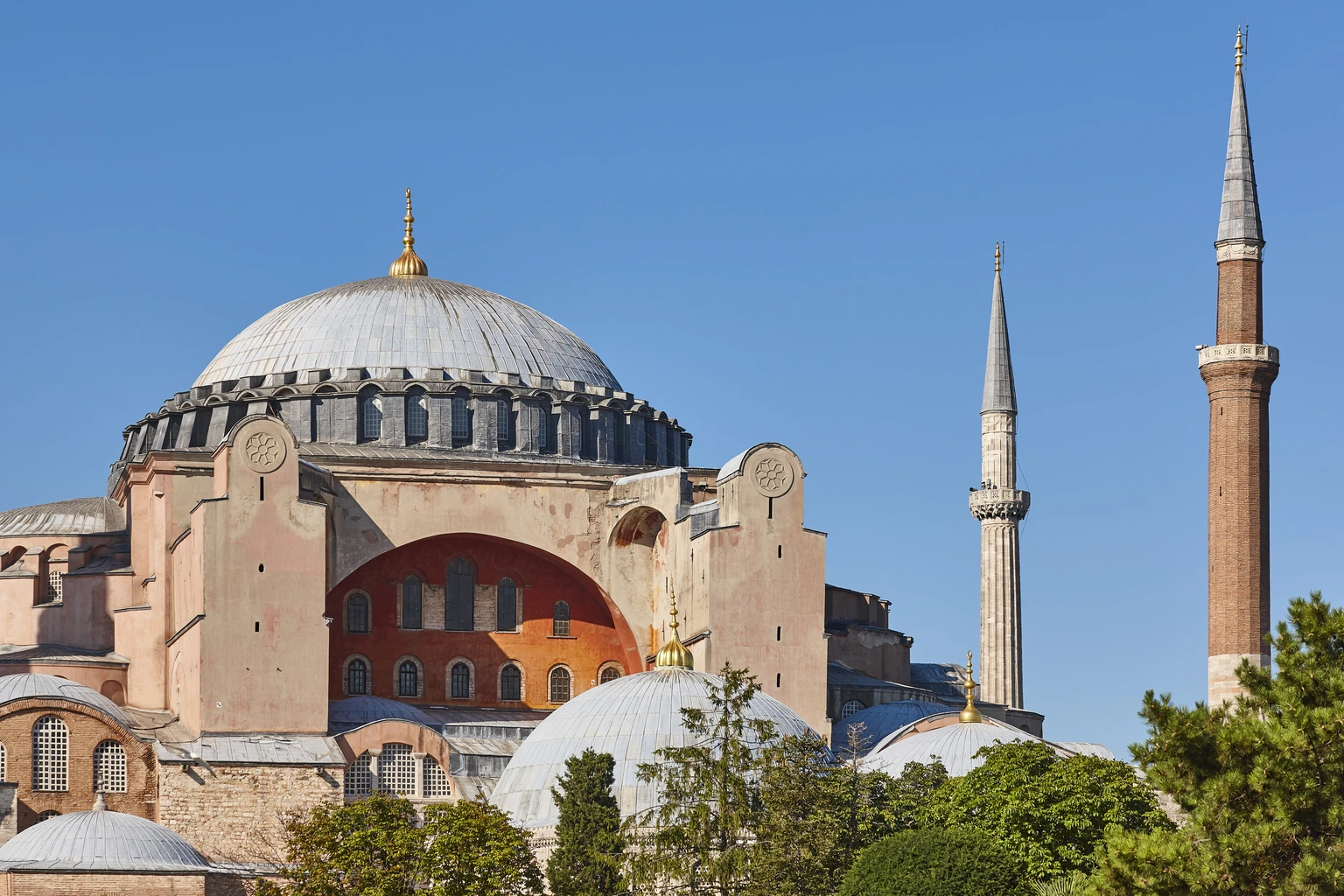
Who Built Hagia Sophia?
Hagia Sophia was commissioned by the Byzantine Emperor Justinian I and designed by two Greek architects — Anthemius of Tralles and Isidore of Miletus. The current building was constructed between 532 and 537 AD.
The Short Answer
The Hagia Sophia you see today was built on the orders of Emperor Justinian I. He hired two of the greatest scientific minds of the age — Anthemius of Tralles and Isidore of Miletus — to design it. Construction began in 532 AD and was completed in just five years, with the church consecrated on 27 December 537 AD.
Construction at a Glance
Built
532–537 AD
Just 5 years
Commissioned by
Justinian I
Byzantine Emperor
Architects
Anthemius & Isidore
Mathematician & geometer
Workforce
~10,000
Workers & craftsmen
The Architects
Justinian did not choose ordinary builders. He chose a mathematician and a geometer — scholars who treated the building as a problem in physics and geometry.
Anthemius of Tralles
Mathematician & Physicist
A renowned mathematician and natural philosopher from Tralles (modern Aydın, Turkey). Anthemius specialised in geometry and the study of conic sections, knowledge he used to design the building's revolutionary curved surfaces and vast central dome.
Isidore of Miletus
Geometer & Engineer
A physicist and geometer from Miletus who taught at Alexandria and Constantinople. Isidore compiled the works of Archimedes and applied advanced engineering to translate Anthemius' bold geometry into a structure that could actually stand.
The Patron: Emperor Justinian I
Justinian I ruled the Byzantine (Eastern Roman) Empire from 527 to 565 AD. After the previous church on the site was destroyed during the Nika riots of 532, Justinian seized the opportunity to build something unprecedented — the largest cathedral in the world, a symbol of imperial and divine power. He spared no expense, drawing marble, columns and materials from across the empire.
“Solomon, I have outdone thee!”
Words traditionally attributed to Justinian I on entering the completed Hagia Sophia, comparing it to the Temple of Solomon in Jerusalem.
Three Churches on One Site
The Hagia Sophia of 537 was actually the third church built on the same spot. Each was destroyed before the current masterpiece rose.
First Church (360 AD)
Inaugurated under Emperor Constantius II, son of Constantine the Great. It had a wooden roof and was burned down during riots in 404 AD.
Second Church (415 AD)
Rebuilt by Emperor Theodosius II. This larger basilica was destroyed by fire during the Nika riots of 532 AD — fragments of its marble are still visible today.
Third Church (537 AD)
The current building, commissioned by Justinian I. Its daring domed design broke completely with the earlier basilicas and has survived for nearly 1,500 years.
Frequently Asked Questions
Who built Hagia Sophia?
Hagia Sophia was built on the orders of Byzantine Emperor Justinian I and designed by two architects, Anthemius of Tralles and Isidore of Miletus, between 532 and 537 AD.
Who designed the Hagia Sophia?
It was designed by Anthemius of Tralles, a mathematician, and Isidore of Miletus, a geometer. Both were Greek scholars chosen by Justinian for their scientific expertise rather than traditional architectural training.
Why did Justinian build Hagia Sophia?
After the earlier church was destroyed during the Nika riots of 532, Justinian wanted to build the largest and most magnificent cathedral in the world as a symbol of imperial and divine power.
How long did it take to build Hagia Sophia?
Remarkably, the main structure was completed in only about five years, from 532 to 537 AD, employing roughly 10,000 workers.
Was Hagia Sophia built by the Ottomans?
No. Hagia Sophia was built by the Byzantines under Justinian I in 537 AD. The Ottomans converted it into a mosque after 1453 and added minarets, mihrab and other Islamic elements, but they did not build the original structure.