Hagia Sophia's Celestial Voyagers: Ancient Astronomical Secrets and 2026's Universal Connections
Hagia Sophia's deep connection to astronomy has fascinated researchers for centuries. This iconic structure, renowned for its architecture and rich history, also holds mysterious links to the universe and celestial bodies. As we move through 2026, new insights and interpretations continue to emerge, revealing more about Hagia Sophia's profound engagement with the cosmos.
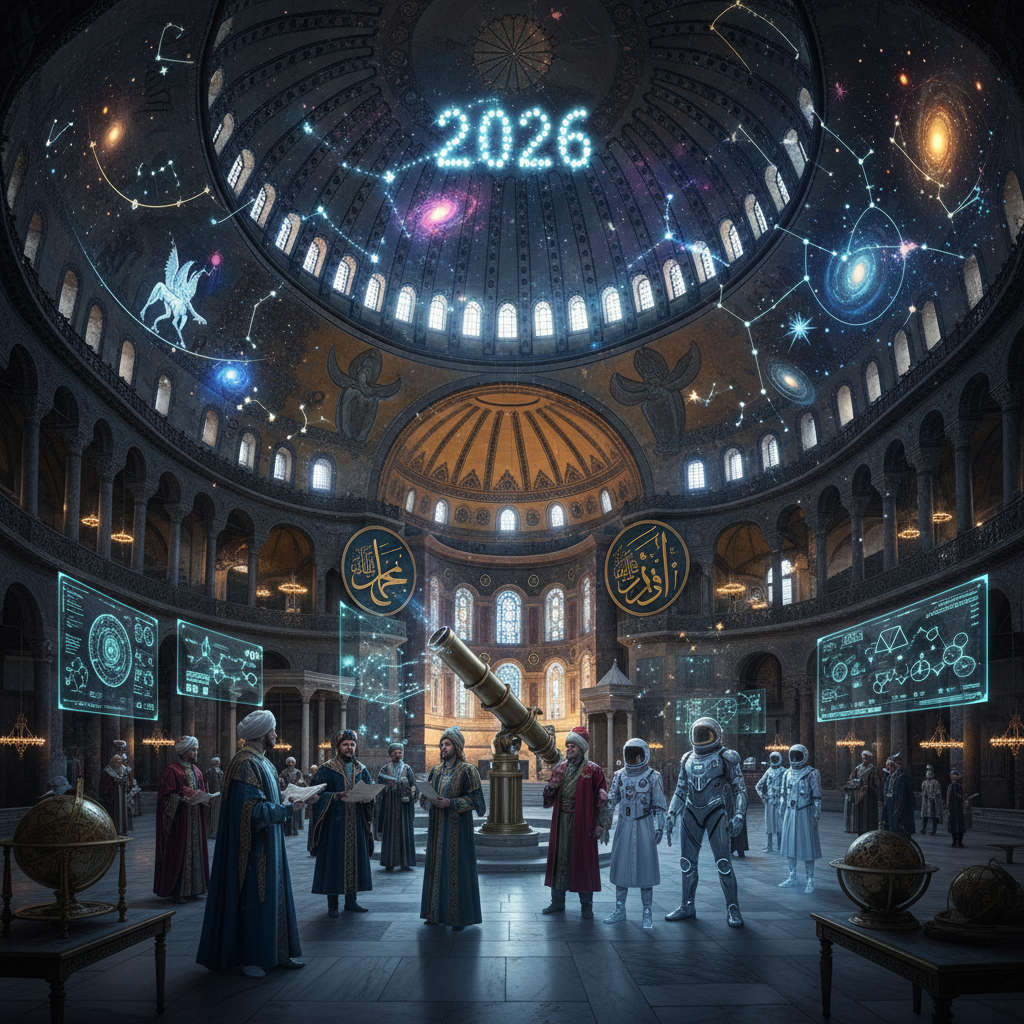
Hagia Sophia Astronomy: Unveiling Ancient Celestial Secrets
The relationship between Ayasofya gökbilim – or Hagia Sophia Astronomy – has captivated researchers for centuries. This magnificent structure enthralls visitors not only with its architecture and history, but also with its mysterious connections to the universe and celestial bodies. As we enter 2026, new discoveries and interpretations regarding Hagia Sophia's astronomical secrets continue to bridge the wisdom of the past with the present, making Hagia Sophia Astronomy a compelling field of study.
Astronomical Inspirations in Hagia Sophia's Construction
The construction of Hagia Sophia reflects a remarkable blend of advanced architectural and engineering skills with deep knowledge of astronomy and cosmology. This unique Byzantine masterpiece was imbued with beliefs about the order of the universe and the divine cosmic structure. Indeed, the building's location, orientation, and even the play of light within it were meticulously planned to synchronize with celestial movements. Learn more about the Hagia Sophia's Evolving Lights and Shadows.
The main axes of the structure were associated with sunrise and sunset points, and the main apse was carefully aligned towards Jerusalem. These precise details suggest that Hagia Sophia was not merely a place of worship, but also functioned as a type of cosmic observatory. Every element of the building reveals the profound respect and knowledge of the sky in that historical period. Research into these mysteries continues vigorously in 2026, deepening our understanding of Hagia Sophia Astronomy.
Emperor Justinian's Astronomical Knowledge
Byzantium under Emperor Justinian was renowned not only for its political and military might but also for its support of scientific advancements. It is widely believed that the architects and engineers involved in Hagia Sophia's construction consulted with the leading astronomers of their time. Through this collaboration, astronomical knowledge was actively integrated into determining the building's light reception, defining its main axis, and even arranging its interior. This deep dive into Ayasofya gökbilim reveals exceptional planning, showcasing the early roots of Hagia Sophia Astronomy.
Significantly, the visual spectacle created by the sun's rays entering at specific times of the year aimed to offer visitors a divine experience. This dramatic play of light can also be interpreted as an adaptation of ancient Egyptian temple traditions into Byzantine architecture, showcasing a continuity of celestial reverence. You can explore more about the historical significance and cultural connections in materials like those found at the Metropolitan Museum of Art's Byzantine art collections.
Cosmic Symbolism and Numerology in Hagia Sophia
Traces of numerological and cosmic symbolism are extensively investigated within the dimensions, proportions, and material choices of Hagia Sophia. The golden ratio, a universal proportion, is known to have contributed both to the aesthetic harmony and structural durability of the building. These proportions were also believed to reflect celestial harmony and divine order. Allegations of hidden mathematical and astronomical codes, present in details such as the number of columns and the arrangement of arches, remain vital subjects of ongoing research. Such in-depth approaches are critically important for understanding the interaction between Hagia Sophia and astronomy, a core aspect of Hagia Sophia Astronomy.
The Conjunction of Sun, Moon, and Hagia Sophia Astronomy
The architecture of Hagia Sophia was ingeniously designed to synchronize with the movements of the sun and moon. On specific days of the year, sunbeams penetrate at angles that illuminate particular points of the structure, believed to convey religious and spiritual messages. This sophisticated play of light, a practice also observed in temples of Ancient Egypt and other ancient civilizations, indicates that Hagia Sophia is a continuation of this profound tradition of Hagia Sophia Astronomy.
- Solstice and Equinox Observations: There are strong theories that Hagia Sophia's main axis relates directly to the sun's positions during the equinoxes and solstices. The distinct ways light falls during these special days underscore the paramount importance of astronomical observations in that era.
- Moon Phases and Interior Illumination: Some researchers propose that specific windows and niches in Hagia Sophia may have been precisely positioned to reflect the light of the moon's different phases into the interior. This could have created a unique atmosphere, especially during night ceremonies. In 2026, these captivating theories are being rigorously tested with advanced modern simulations, contributing to our understanding of Hagia Sophia Astronomy.
- Star Charts in Domes: Although no clear star charts have survived directly to the present day, it is hypothesized that dome decorations from the Byzantine period might have represented specific star positions or constellations. Such detailed decorations are a strong indication that the celestial dome was regarded as a sacred space during that era, further linking to Hagia Sophia Astronomy.
Hagia Sophia and Byzantine Cosmology
In the Byzantine world, cosmology was an integral part of both religious and scientific thought. It was widely believed that the universe was divinely created and operated within a specific, sacred order. Therefore, Hagia Sophia can be viewed as a microcosm of this cosmic order. All elements of the structure were meticulously designed to reflect celestial hierarchy and divine arrangement, a testament to the principles of Hagia Sophia Astronomy.
Byzantine emperors saw themselves as representatives of the divine order on Earth. Consequently, the empire's most magnificent structure, Hagia Sophia, was replete with elements symbolizing this cosmic hierarchy and the emperor's pivotal place in the universe. The connection inherent in Ayasofya gökbilim represents a profound philosophical and religious perspective, far beyond mere architectural detailing. Discover more about the intricate Hagia Sophia's Traveling Artisans who shaped its grandeur.
Astronomical Motifs in Byzantine Art
While direct astronomical symbols may not be obvious in Hagia Sophia's mosaics or other decorations, the use of cosmic elements is a common theme in Byzantine art generally. Celestial spheres, angelic choirs, and star embellishments around saint figures can be interpreted as reflections of the era's astronomical beliefs embedded in artistic expression. Some experts claim that certain niches or specific points within Hagia Sophia might have been adorned with visuals referring to particular astronomical events, further deepening the mystery of Ayasofya gökbilim and its connection to Hagia Sophia Astronomy. Further details on Hagia Sophia's Traveling Artists illustrate this rich artistic legacy.
Ancient Observatories and the Hagia Sophia Connection
Although Hagia Sophia did not function as a direct observatory, it is widely believed that the structure's construction and design were inspired by astronomical observation practices from antiquity. Specifically, astronomical knowledge from the Hellenistic and Roman periods significantly influenced Byzantine architecture. This crucial transfer of knowledge allowed Hagia Sophia to serve as a kind of "celestial calendar" or "cosmic clock," a fascinating aspect of Hagia Sophia Astronomy.
Unraveling Hagia Sophia Astronomy with Modern Science
Today, thanks to advanced technologies, new and exciting information about Hagia Sophia's astronomical secrets is being uncovered. Laser scanning, 3D modeling, and sophisticated computer simulations allow us to understand in much greater detail how the structure interacted precisely with the movements of the sun and moon. As of 2026, such research has gained significant momentum and continues to bring Hagia Sophia's ancient secrets into the light, enhancing our knowledge of Hagia Sophia Astronomy.
Utilizing modern astronomical software, ancient sky conditions can be accurately simulated, revealing which specific astronomical events correlate with the light plays observed within Hagia Sophia's structure. These in-depth studies unequivocally prove that Hagia Sophia is not only an architectural marvel but also a profound astronomical wonder, a cornerstone of Hagia Sophia Astronomy.
Virtual Reality and the Hagia Sophia Experience
With advancing technology, tourists and history enthusiasts can now experience Hagia Sophia's astronomical features through innovative virtual reality (VR) and augmented reality (AR) applications. These immersive applications demonstrate to visitors how Hagia Sophia interacted with sunlight and moonlight across different seasons and times of day, making this mysterious historical connection far more comprehensible. In this way, the intricate relationship highlighted by Ayasofya gökbilim becomes more accessible and engaging for today's diverse visitors, further promoting interest in Hagia Sophia Astronomy. For an overview of how technology enhances historical experiences, refer to articles from sources like Smithsonian Magazine on VR in museums.
New Discoveries and Interpretations in 2026
Recent research in 2026 has unearthed some previously unnoticed astronomical alignments within Hagia Sophia's intricate architecture. Critically, new theories suggest that some small holes or niches within the structure may have been precisely used to mark the rising moments of specific stars or planets. These compelling findings indicate that Hagia Sophia is not only an important representative of Byzantine architecture but also a significant testament to early medieval astronomy, a key area of Hagia Sophia Astronomy.
Furthermore, new geological studies on the origins of materials used in Hagia Sophia's construction and the ancient routes by which these materials were transported also illuminate how developed the global knowledge network and communication routes of that period truly were. This indirectly demonstrates the vast scientific and technical accumulation characteristic of the era.
Conclusion: Hagia Sophia Astronomy – Hagia Sophia's Dance with the Stars
Hagia Sophia, beyond being merely a place of worship or a historical monument, is a structure profoundly intertwined with astronomy, carrying deep and multifaceted meanings. The connections of Ayasofya gökbilim, hidden within its architecture, strategic location, and even its mesmerizing light plays, serve as compelling evidence of an intellectual heritage extending from millennia ago to the present day. Even in 2026, the secrets of this magnificent structure are far from fully resolved, harboring countless mysteries awaiting discovery by future generations, especially in the realm of Hagia Sophia Astronomy.
A tourist or history enthusiast visiting Hagia Sophia will encounter more than just stone and mortar within its venerable walls; they will sense the empire's profound perspective on the universe, its tireless search for cosmic order, and its ancient, timeless dance with the stars. This universal connection is undoubtedly one of the foundational cornerstones of Hagia Sophia's enduring permanence and unparalleled grandeur. For those planning their visit, consult the Hagia Sophia Traveler's Guide 2026.