Codes in Hagia Sophia's Stones: Symbols and Mysteries Every Visitor Must Understand (2026)
Hagia Sophia, a breathtaking masterpiece in Istanbul, is more than just a historical structure. It's a treasure trove of hidden symbols and profound mysteries woven into its very fabric. From intricate mosaics to complex architectural codes, this 2026 guide delves into the untold stories and spiritual significance embedded within Hagia Sophia's stones, offering visitors a deeper understanding of its timeless allure.
Hagia Sophia: Unveiling Its Enduring Symbols
Rising in the heart of Istanbul, Hagia Sophia, one of the most fascinating structures in human history, transcends being merely a place of worship or a museum. This extraordinary edifice harbors deep meanings and mysterious messages hidden for thousands of years within its walls, mosaics, and architecture. Whispering a story in every corner, Hagia Sophia offers visitors not only a visual feast but also a rich experience where history, faith, and art converge. In this article, focusing on Hagia Sophia: Unveiling Its Enduring Symbols, we will explore the codes, their meanings, and the fascinating stories behind every stone of this sacred structure. Consequently, these symbols, which every traveler planning to visit Hagia Sophia in 2026, should know, will offer a profound understanding and an unforgettable experience.
Hagia Sophia's Architectural Wonders and Its Enduring Symbols
Since its construction, Hagia Sophia has inspired admiration with its architectural genius. Every detail of the structure represents the pinnacle of engineering and artistic understanding of its era. Furthermore, it carries deep symbolic meanings. These symbols narrate the story of coexistence and transformation at the intersection of Christian and Islamic faiths. For more on its construction, delve into Hagia Sophia's Architecture: Construction Techniques and Unknown Details from the Ancient World to 2026. Understanding these architectural elements is key to appreciating Hagia Sophia: Unveiling Its Enduring Symbols.
The Meaning of Domes and Semi-Domes
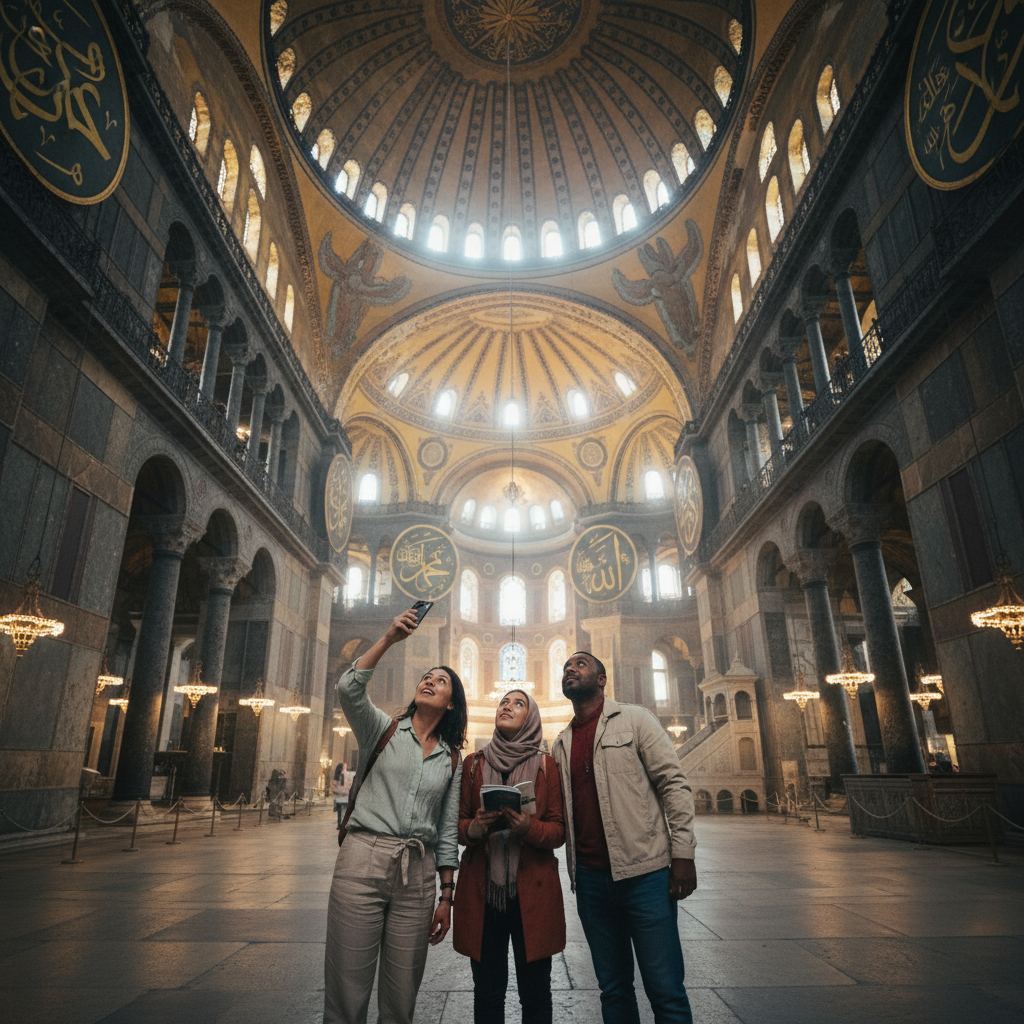
Hagia Sophia's iconic main dome is not only a structural achievement but also a cosmic symbol. Representing the infinity of the universe and divine power, this colossal dome seemingly brings the sky down to earth. Moreover, the semi-domes support the main dome, emphasizing the continuity and balance of this divine order. This architectural arrangement has therefore continued to be interpreted differently in both Byzantine and Ottoman periods. Discover more about these interpretations in Hagia Sophia's Cosmic Connections: Celestial Architecture and Star Maps (2026).
- Main Dome: Represents God's firmament and the universe's centrality.
- Semi-Domes: Show that earthly elements balancing and supporting the main dome are united with the divine order.
- Light: Natural light filtering through the dome symbolizes divine enlightenment and the holy spirit.
Origin of Columns and Marbles
The monolithic columns and colored marbles used inside Hagia Sophia were brought from various corners of the ancient world. These columns, originating from the Temple of Artemis in Ephesus, the Temple of Apollo in Tarsus, or ancient Rome, indicate that the structure was built not just on the accumulation of Byzantium but of all civilizations. Each column represents a different history and culture, emphasizing Hagia Sophia's cosmopolitan nature. Distinctively, the patterns in the marbles, like abstract works of art, reflect the complexity of the human soul and the diversity of life. For a deeper understanding of its materials and their origins, you might want to visit the Metropolitan Museum of Art's resource on Hagia Sophia. These materials contribute to Hagia Sophia: Unveiling Its Enduring Symbols.
- Green Marbles: Brought from Thessaly, symbolizing imperial power.
- Purple Marbles: Brought from Egypt, representing imperial nobility and splendor.
- Column Capitals: Contain symbols of early Christianity (e.g., cross, fish).
Mysterious Mosaics: Hagia Sophia's Enduring Symbols and Iconography
The mosaics adorning the walls of Hagia Sophia are some of the most important examples of Christian art. These mosaics stand out not only for their aesthetic beauty but also for the deep theological and historical Hagia Sophia symbols they carry. Indeed, every figure, every color, conveys a message. For a comprehensive look at the narratives within these artistic marvels, consult Whispers on Hagia Sophia's Walls: Unseen Stories from Past to Present. These mosaics are crucial for Hagia Sophia: Unveiling Its Enduring Symbols.
Mosaic of the Virgin Mary and Child Jesus
Located in the apse's upper section, this magnificent mosaic is one of Hagia Sophia's oldest and most sacred symbols. The Virgin Mary, holding the Child Jesus in her lap, is regarded as the church's main protector and a symbol of divine grace. This mosaic instantly draws eyes upon entering the building and represents the core of Christian faith.
- Virgin Mary: Mother of God, personification of the church, and intercessor.
- Child Jesus: The Savior, divine grace, and the beginning of the new covenant.
- Gold Background: Symbolizes the brilliance of heaven, the divine world, and eternity.
Deësis Mosaic: Humanity’s Plea
Located in the South Gallery, the Deësis Mosaic is one of the most striking examples of Christian iconography. With Christ at the center, flanked by the Virgin Mary on one side and John the Baptist on the other, this composition represents humanity's plea on judgment day. The human expression and depth in the figures constitute an artistic pinnacle. The Dumbarton Oaks Research Library and Collection also provides extensive scholarly resources on Byzantine art, including Hagia Sophia's mosaics.
- Jesus Christ (Pantokrator): Ruler and judge of the universe, symbolizing mercy and justice.
- John the Baptist: Herald of Jesus Christ and intercessor.
- Emotional Expression: Symbol of supplication and pleading for mercy for humanity's sins.
Emperor and Empress Mosaics
The Komnenos Dynasty and Zoe Dynasty mosaics in the South Gallery reveal Hagia Sophia's connection to Byzantine imperial history. These mosaics depict emperors and empresses presenting offerings to Christ or the Virgin Mary. This is a powerful set of Hagia Sophia symbols showing that earthly power is subject to divine authority and the central role of the church in political life.
- Emperor Figures: Rulers who govern by divine will and make donations to the church.
- Empress Figures: As wives of emperors, they present their devotion to religion alongside them.
- Offering Presentation: Dedication of imperial power and wealth to the church.
Ottoman Period Additions: New Hagia Sophia Symbols and Traces
With Sultan Mehmed the Conqueror's conquest of Istanbul in 1453, Hagia Sophia was converted into a mosque. Furthermore, this transformation brought new symbols and architectural additions to the structure. These additions, combined with the Byzantine heritage, further enriched Hagia Sophia's multi-layered identity. These changes were made with a delicate balance between the existing Hagia Sophia symbols within the structure. Learn more about its comprehensive history and transformation in Hagia Sophia's Mysterious Layers: Your A-Z Tourist Guide to Everything You Need to Know.
Calligraphic Panels and Islamic Inscriptions
One of the most prominent Ottoman-era additions to Hagia Sophia is the enormous calligraphic panels. These panels bear the names of Allah, Muhammad, the Four Caliphs, and Hasan, Hussein. These works of calligraphy represent the fundamental tenets of the Islamic faith and emphasize the building's identity as a mosque. Meanwhile, the mihrab and minbar took their place as important Hagia Sophia symbols indicating a new direction of worship.
- Panels by Calligrapher Kazasker Mustafa İzzet Efendi: Contain the pillars of Islam and sacred names.
- Mihrab: The mihrab, pointing towards the Kaaba (Qibla), determines the direction Muslims face during prayer.
- Minbar: The place where sermons are delivered, the pulpit from which religious sermons and teachings are spread.
Minarets and Ablution Fountain (Sadırvan)
The most significant Ottoman additions that changed Hagia Sophia's exterior appearance are its four minarets. Built at different times, these minarets are both a clear indication of the building's mosque identity and an indispensable part of Istanbul's skyline. The şadırvan (ablution fountain) is a structure used for ritual washing, symbolizing cleanliness and purity. These elements are integral to Hagia Sophia: Unveiling Its Enduring Symbols.
- Minarets: Added for calling the adhan (prayer call) and emphasizing Hagia Sophia's Islamic identity.
- Sadırvan: Symbolizes purification and cleansing before worship.
Other Important Hagia Sophia Symbols and Mysteries
Hagia Sophia is a rich ensemble of symbols, not only through its large-scale architectural components and mosaics but also through its small, yet meaningful details. These details further reinforce the spiritual depth of the structure and its place in history. Even in 2026, these symbols continue to impress visitors as they did on day one. Exploring these helps in Hagia Sophia: Unveiling Its Enduring Symbols.
The Sweating Column (Wishing Column)
Located in the northwest nave of Hagia Sophia, this column with a special hole is known as the "Sweating Column" or "Wishing Column." According to legend, it is believed that wishes of those who insert their thumb into this hole and rotate their hand 360 degrees will be granted. This column is associated both with miraculous powers attributed to Byzantine Emperor Justinian I's Vision: Building Hagia Sophia and with the healing power of Christian saints. Today, it is a popular stop for tourists.
- Miraculous Power: Especially in the Byzantine period, it was believed to heal the sick.
- Granting Wishes: In modern times, it has become synonymous with the tradition of making wishes.
- St. Gregory Thaumaturgus: One of the legends suggesting the column's association with the holy spirit is linked to this saint.
Viking Inscriptions (Graffiti)
In the galleries of Hagia Sophia, ancient Viking inscriptions (runic writings) are carved onto marble railings. These inscriptions are proof that Vikings, or Varangian Guards, who served as mercenaries in the Byzantine Empire, visited Hagia Sophia and left their mark. This is one of the unique Hagia Sophia symbols demonstrating the structure's universal appeal and how it attracted people from different cultures. These inscriptions serve as a historical bridge dating back to the 9th and 10th centuries. For more on these fascinating historical connections, you can explore academic resources such as those found on Cambridge University Press's Journal of Byzantine Studies.
- Runic Alphabet: Letters used in writing ancient Norse languages.
- Varangian Guards: Viking mercenaries who served in the Byzantine Empire.
- Cultural Interaction: Concrete evidence of interaction between different civilizations.
The Royal Gate and The Imperial Gate
Hagia Sophia has three main entrance gates. The large central gate is known as the "Imperial Gate" because it was used by the emperor, especially during ceremonies. On the marble pavement laid out as one enters this gate, common symbols of the empire and the church can be found. As a result, the mosaics in the entrance section also typically depict emperors and their devotion to Christ, thereby reinforcing the symbolic importance of this gate. These gates are also part of Hagia Sophia: Unveiling Its Enduring Symbols.
- Imperial Gate: The main entrance used only by emperors, symbolizing power and authority.
- Royal Gate: Sometimes referred to as the "Beautiful Gate," opening into the inner courtyard.
- Bronze Gates: Dating from the Roman period, showing historical continuity.
Transformation in Hagia Sophia and the Evolution of Its Enduring Symbols
Hagia Sophia's history is filled with a series of transformations. Its conversion from a church to a mosque, from a museum back to a mosque, demonstrates how the building's symbols have also evolved and acquired different meanings. These transformations underscore that Hagia Sophia is more than just a structure; it is a living witness to human history and changes in faith.
During the Christian era, Hagia Sophia symbols generally glorified divine hierarchy, sacred legends, and imperial power. After its conversion to a mosque, Islamic motifs and inscriptions came to the forefront. However, in these transitions, existing symbols were often reinterpreted within new contexts rather than completely destroyed. For instance, Christian figures, though covered with plaster, continued their existence. This situation also reveals Hagia Sophia's inclusive and harmonious nature. To understand its role as a sacred space, consider Hagia Sophia's Legacy of Faith: Religious and Cultural Impacts of a Sacred Space Shaping Civilizations.
Today, when visiting Hagia Sophia, one can see both Christian and Islamic symbols together. This unique amalgamation serves as a reminder of how different faiths and cultures can coexist under one roof. As of 2026, this structure continues to carry a message of peace and tolerance for both local and foreign tourists. This coexistence is a powerful aspect of Hagia Sophia: Unveiling Its Enduring Symbols.
In summary, every detail of Hagia Sophia offers visitors a rich cultural and spiritual experience. The Hagia Sophia symbols within the structure are not merely patterns carved into stones, but deep stories and spiritual legacies extending from the past to the present. Understanding these symbols is key to truly experiencing Hagia Sophia: Unveiling Its Enduring Symbols.