Hagia Sophia's Legacy of Faith: Religious and Cultural Impacts of a Sacred Space Shaping Civilizations
Hagia Sophia, a monumental structure in Istanbul, stands as a living testament to centuries of intertwined religious and cultural history. From its origins in the Eastern Roman Empire through the Ottoman era, its legacy showcases architectural genius and the profound influence of a sacred space on shaping civilizations.
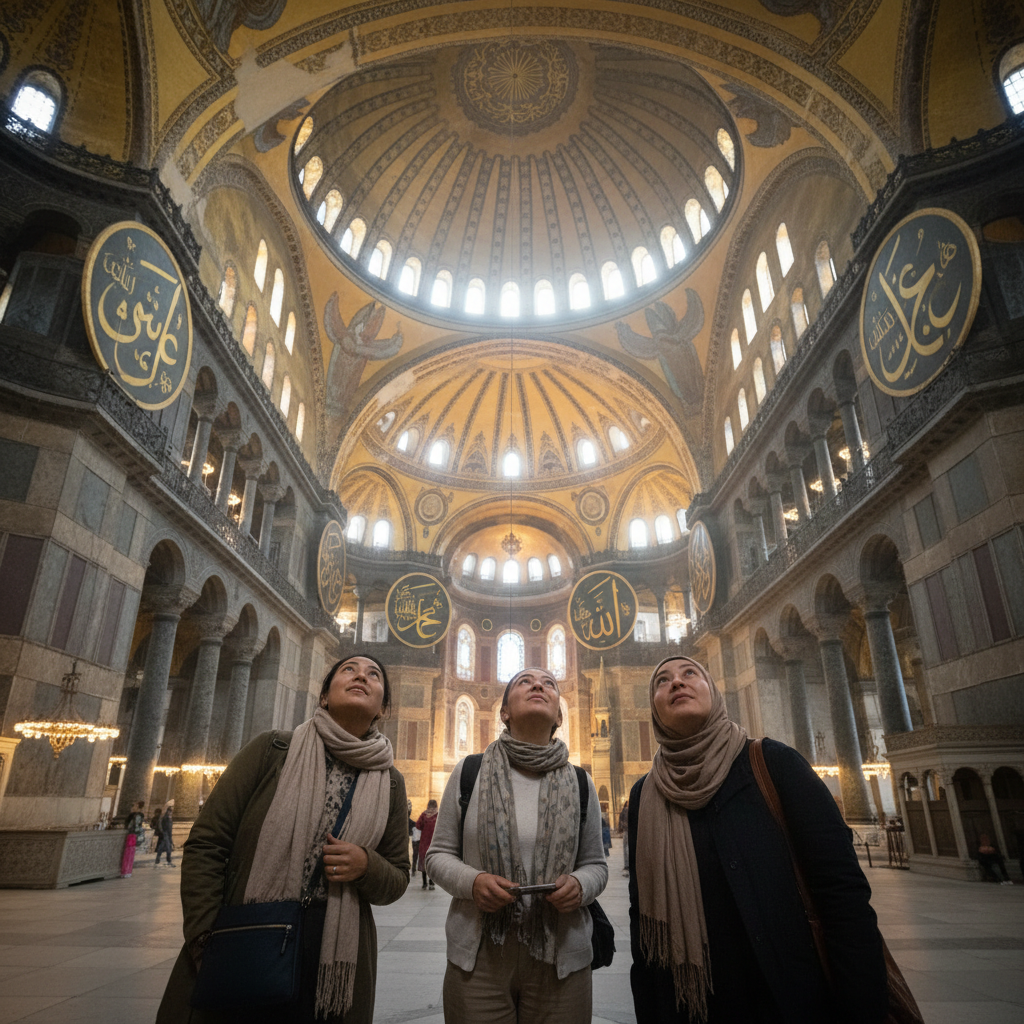
Hagia Sophia: A Sacred Heritage
Standing for centuries in the heart of Istanbul, Hagia Sophia: A Sacred Heritage holds a unique position. This monumental structure is not only an architectural masterpiece but also a living history bearing the religious and cultural traces of different civilizations. In its journey from the Eastern Roman Empire to the Ottoman Empire and to the present-day Republic of Turkey, Hagia Sophia has been a great symbol for both the Christian and Islamic worlds, embodying a truly sacred heritage. Hagia Sophia: Visitor Experience & Cultural Impact
Origins of Hagia Sophia and its Early Religious Heritage
Hagia Sophia was first built as a basilica in 360 AD by the Roman Emperor Constantius II. However, this first structure was destroyed twice during riots. The magnificent structure we see today was built by Emperor Justinian in 532 AD and took only five years to complete. This early history laid the foundation for Hagia Sophia's sacred heritage.
Hagia Sophia during the Byzantine Period: Heart of Eastern Orthodoxy
Throughout the Byzantine Empire, Hagia Sophia was the largest and most important church of Eastern Orthodox Christianity. Imperial coronations, religious ceremonies, and important state affairs were held here, solidifying its role as a sacred heritage site.
- Many emperors, patriarchs, and religious leaders had their funeral services held at Hagia Sophia.
- It witnessed important debates and developments in the history of Christianity, including periods of iconoclasm.
- With its mosaics, frescoes, and monumental dome, it represents the pinnacle of Byzantine art and architecture, contributing to its sacred heritage.
Hagia Sophia's Architectural Marvels and Religious Significance
The architecture of Hagia Sophia is a combination of engineering genius and religious symbolism. Its massive dome, in particular, is considered one of the greatest technological achievements of its era and creates a celestial atmosphere. Its interior offers a sacred experience with its play of light and golden mosaics.
Every corner of the structure reflects the depth of the Byzantine Empire's religious faith and artistic aesthetic. Even today, this work, which captivates its visitors, is one of humanity's common Hagia Sophia religious heritage values, truly a sacred heritage.
Ottoman Period: Transformation into a Mosque and a New Hagia Sophia Religious Heritage Identity
With the conquest of Istanbul in 1453, Hagia Sophia was converted into a mosque by Sultan Mehmed the Conqueror. This transformation meant a radical change in the building's religious identity, but its architectural integrity was largely preserved, continuing its sacred heritage in a new form.
Ottoman Architectural Additions and Restorations
During the Ottoman period, important additions were made to Hagia Sophia, such as minarets, madrasahs, tombs, and soup kitchen. These additions reinforced the building's function as an Islamic place of worship and made it the most magnificent mosque of the Ottoman capital. The famous architect Mimar Sinan also strengthened the structure by solving Hagia Sophia's static problems.
While a mihrab, minbar, and pulpit were added to the interior of the building, the mosaics were covered in accordance with regulations. These changes ensured that Hagia Sophia's historical evolution became a unique structure bearing the traces of both Christian and Islamic cultures, a testament to its sacred heritage.
Hagia Sophia's Influence on Islamic Architecture
After being converted into a mosque, Hagia Sophia became a source of inspiration for Ottoman architecture. Traces of Hagia Sophia's plan and dome system are clearly visible in Mimar Sinan's masterpieces such as the Selimiye and Süleymaniye mosques. This shows that Hagia Sophia is a fundamental Hagia Sophia religious heritage not only for Byzantine but also for Ottoman architecture, solidifying its sacred heritage status.
In the development of dome architecture in mosques, the engineering and aesthetic solutions offered by Hagia Sophia played a critical role. The building thus acted as a bridge bringing together the architectural styles of different faiths, further enriching its sacred heritage.
Hagia Sophia: The Meeting Point of Civilizations and a Sacred Heritage
Throughout history, Hagia Sophia has been a center where different civilizations and faiths met and interacted. During its periods of service as a church and a mosque, it witnessed the cultural and artistic exchange between East and West, truly embodying a sacred heritage.
Religious Symbolism and Spatial Experience
Hagia Sophia's interior allows visitors to experience the profound symbolism of both faiths. Mosaics from the Christian period and calligraphy from the Islamic period coexist peacefully in the same space. This is a powerful example of how different faiths can coexist under one roof, contributing to its sacred heritage.
- Mosaics with gold leaf depicting Jesus, Mary, and saints.
- Calligraphic artworks on large panels with the names of Allah, Muhammad, Abu Bakr, Omar, Osman, Ali, and Hasan, Husayn.
- This unique combination reinforces the building's universal Hagia Sophia religious heritage value, making it a truly sacred heritage.
Hagia Sophia's Influence on Literature and Art
Hagia Sophia has inspired countless writers, poets, painters, and artists for centuries. It has featured in many works, from travelogues to novels, from poems to songs. Its mysterious atmosphere, colossal size, and religious connotations have made it an endless source for literary and artistic creation, reflecting its sacred heritage.
Especially through the eyes of Western travelers, Hagia Sophia has been a symbol representing the mystery and splendor of the East. For Ottoman poets, it was a mark of holiness and conquest, a testament to its sacred heritage.
Hagia Sophia in the Modern Era: From Museum to Place of Worship and a Sacred Heritage
With the establishment of the Republic of Turkey, Hagia Sophia was converted into a museum in 1934 by order of Mustafa Kemal Atatürk. This decision aimed to preserve the structure as a universal cultural heritage and open it to visitors of different faiths, recognizing its sacred heritage.
Museum Period and Restoration Works
During the period when Hagia Sophia was a museum, both Christian and Islamic artifacts were restored and brought to light with the contributions of experts from around the world. Especially the uncovering of the covered mosaics revealed the multi-layered history of the structure. As a museum, it hosted millions of visitors and solidified its place on the world cultural heritage list, emphasizing its sacred heritage.
Its inclusion in the UNESCO World Heritage list has certified how valuable Hagia Sophia's religious heritage is, not only for the Turkish nation but for all humanity, truly a sacred heritage.
Opening to Worship and Future Perspective: Hagia Sophia Religious Heritage and Cultural Identity
In 2020, Hagia Sophia was reopened for worship as a mosque. This decision resonated widely in the international community and brought with it different opinions. The status of Hagia Sophia continues to be a globally debated topic, yet its sacred heritage remains undeniable.
Whatever Hagia Sophia's future position may be, this unique structure will continue to stand at the intersection of human history, faiths, and civilizations. It will offer every visitor an unforgettable experience with its deep history, rich culture, and spiritual atmosphere, a true sacred heritage.
Visiting Hagia Sophia: Approaching a Mystical Experience of Sacred Heritage
Visiting Hagia Sophia is not just seeing a historical building, it is like taking a journey through time. When you step inside, you will feel the energy of different faiths and periods, and you will witness the stories told by every stone on the walls, experiencing its sacred heritage firsthand.
Tips for Tourists Visiting Hagia Sophia: A Sacred Heritage Site
- Visiting Hours: Check current visiting hours and prayer times. There may be entry restrictions during special times such as Friday prayers.
- Dress Code: As it is a mosque, it is recommended for women to wear headscarves and cover their shoulders/knees, and for men to avoid open clothing such as shorts. Headscarves can be provided at the entrance.
- Guided Tours: You might consider taking a guided tour to fully understand the rich and complex history of the structure and its sacred heritage.
- Attention to Detail: Take plenty of time to observe the mosaics, calligraphic writings, architectural details, and how the light plays on the dome.
With its Hagia Sophia religious heritage value, it continues to welcome visitors from all over the world, standing as a unique place where each individual finds different meanings in their spiritual journey, truly a sacred heritage.